
Communication and Motivation | Transparent Compensation
Transparent compensation isn't a requirement. It's the most cost-effective way to build trust within a team.
Under EU Directive 2023/970, employees have the right to know their pay range, compensation criteria, and pay progression rules, and organizations with 100+ employees must report their pay gap. The WinWin App’s Transparent Pay module turns these obligations into a functional system: a clear view of pay for employees and full management of the pay structure for managers and HR.
Module implementation: 2–4 weeks on average. Compliance with EU Directive 2023/970 without having to build the entire process from scratch.
You still have time, but less than you think.
The recruitment phase has been in effect in Poland since December 24, 2025. Full implementation—including employees’ right to information, job evaluation, and reporting the pay gap—is pending the passage of Act UC127. This postponement is not a reprieve, but rather the last opportunity to streamline the pay structure without the pressure of a deadline.
24.12.2025
Effective today—salary ranges in job postings, a ban on asking about past earnings, and neutral job titles
2027
Expected date for full implementation—Act UC127 takes effect 6 months after its promulgation
100+
employees – the threshold above which there is an obligation to report the pay gap; exceeding a 5% unexplained pay gap triggers a joint pay assessment
60,000 PLN
The bill lists 13 violations—each punishable by a fine of up to 60,000 zł separately
Bill UC127 (as of April 29, 2026) has not yet been enacted—the deadlines and amounts of penalties are subject to change. However, the list of obligations stems directly from Directive 2023/970 and will remain essentially unchanged: job evaluation, transparent criteria, the employee’s right to information, and reporting the pay gap.
The employee understands how much they earn and why
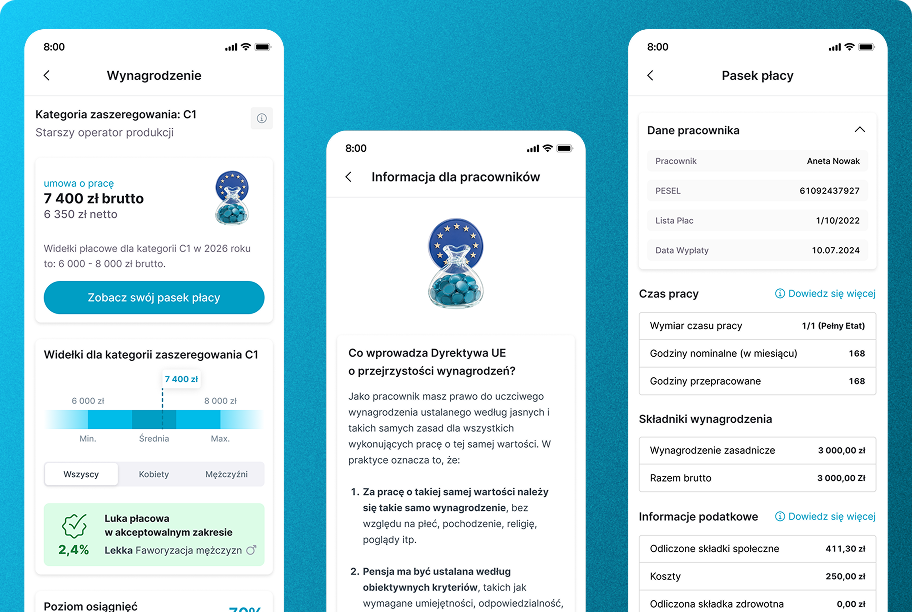
Instead of speculation and comparisons in the hallway—one clear overview on your phone. Every employee can see their pay situation in the context of the compensation policies and their specific employee category.
Your Paystub, Always at Your Fingertips
Components of compensation, working hours, social security contributions, and taxes—with PDF export, no need to ask HR.
Pay Grade and Pay Range
An employee can see their pay grade, the applicable minimum–average–maximum pay range, and where their salary falls within that range.
Compliance with the Employer's Duty to Provide Information
A comparison of women’s and men’s salaries within the same pay grade—with clear information on whether the difference falls within an acceptable range.
Performance-Based Pay Increases
Level of professional achievement (commitment, effectiveness, skills) – development as the primary factor shaping salary progression.
Clear guidelines, simple language
The “Information for Employees” section explains the principles of the Directive, the concepts of job evaluation, and pay grade categories in simple language.
Managers manage the pay structure, not the spreadsheets
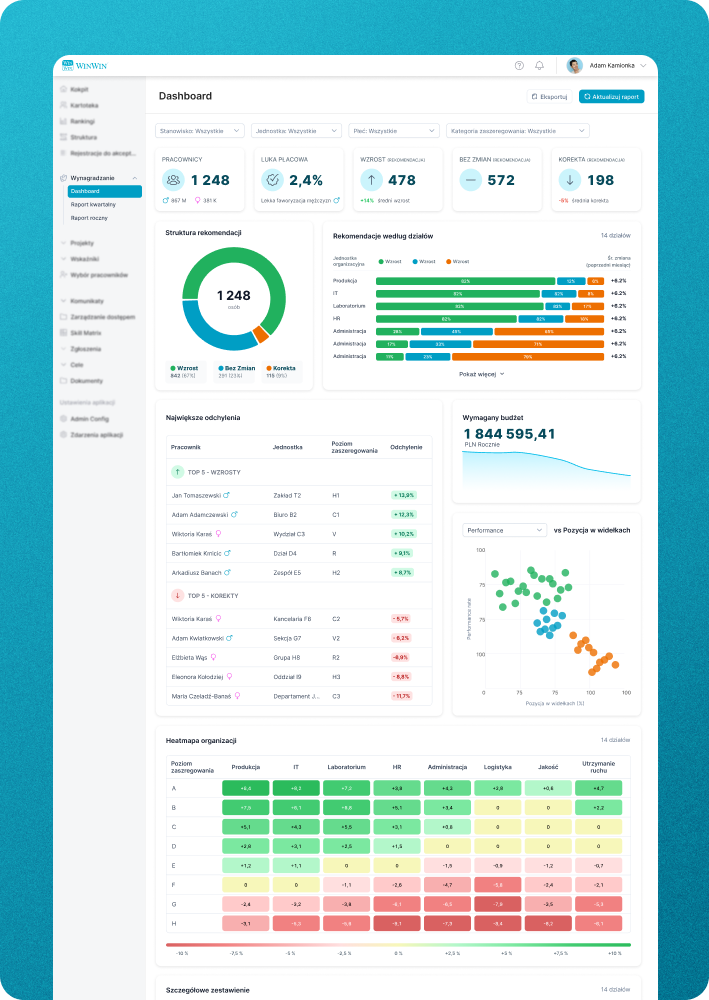
The web version provides HR departments and management teams with a simple tool for managing compensation policies: from defining pay grades to creating a job grading system, to generating automated reports (including pay gap reports) and recommendations for pay adjustments.
Pay Grade Categories and Pay Ranges
Defining pay grade categories and annual and monthly pay ranges (min–avg–max), with monitoring of the percentage deviations from the lower and upper limits of the ranges.
Job Classification Schedule
Assigning positions to pay grades, defining skills, responsibilities, effort levels, and working conditions—the foundation for a reliable and objective job evaluation.
Reporting Dashboard
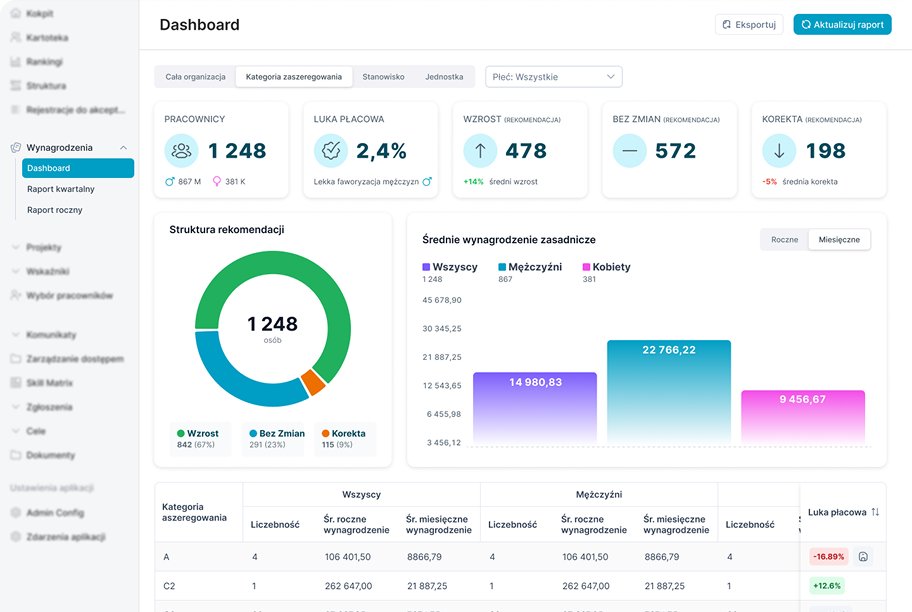
Executive summary, organizational heat map, performance-vs.-position-in-the-range analysis, and quarterly and annual reports—valuable insights for making business decisions.
Recommendations for Wage Equalization
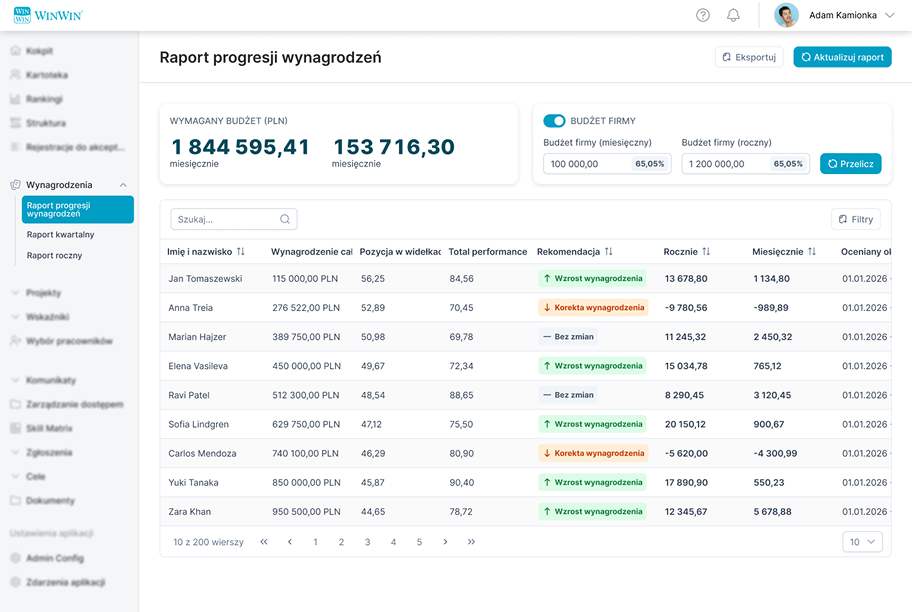
The system recommends who should receive a raise, where salaries should remain unchanged, and where they should be adjusted—with justifications based on data and the impact on the budget.
Arguments for Difficult Conversations
A manager goes into a pay raise discussion armed with data: the employee’s salary range, performance metrics, and a fact-based history of their professional achievements—rather than relying on unreliable intuition.
Discretion and Excel vs. Win-Win
Many organizations still manage compensation using spreadsheets and based on past decisions. This model won’t hold up when an employee first requests pay information—and the reversed burden of proof means that the employer will have to justify every discrepancy.
The current model
- Pay decisions based on discretion and "history"—difficult to justify using objective criteria.
- The pay range is listed only in the HR spreadsheet—employees aren't familiar with the rules, so they're just guessing.
- A pay gap calculated manually, once a year (or not at all) — the risk of exceeding the 5% threshold without the organization’s knowledge.
- The manager is negotiating a raise without any data—emotions instead of arguments.
- Report for regulatory authorities = weeks of analytical work in Excel.
Transparent Compensation Module
- A consistent system of pay grades and pay ranges—every pay decision is based on the structure.
- Employees can see their salary range and where they fall within it—in the app, in real time, without intermediaries.
- The pay gap is monitored on an ongoing basis, broken down by pay grade and gender.
- Compensation Recommendations: Who to compensate, where to make adjustments—with the budgetary impact calculated in advance.
- Quarterly and annual reports generated automatically—ready to meet reporting requirements.
- Job evaluations and negotiations with unions conducted with WinWin experts—you won’t have to navigate the law on your own.
Features tailored to different groups
To the Board of Directors
Control over the payroll budget and regulatory risk. Transparency as a competitive advantage in the battle for talent.
For Leaders
Data for salary and promotion discussions: position within the pay range, performance, and recommendations. Fewer conflicts, lower turnover.
For HR
A single compensation policy management system: structure, pay ranges, pay gaps, and reporting—plus expert support in job evaluation and negotiations with employee representatives.
For employees
Clear answers to the questions: How much do I earn? Why do I earn that much? And what can I do to earn more? A sense of fairness instead of guesswork.
Many employer responsibilities and one solution that covers them all.
The draft bill implementing the directive explicitly lists the employer’s responsibilities. The Transparent Compensation Module handles the technology-related obligations, while the WinWin team of experts takes care of the tasks that no system can do for you—job evaluation and negotiations with employee representatives.
Article 6, paragraph 1
Easy access to pay criteria and pay grades
Employers provide employees with easy access to the criteria for determining compensation, its levels, and the rules for pay increases.

Article 4, paragraph 4
Objective Job Evaluation
Compensation structures must allow for the evaluation of positions based on objective, gender-neutral criteria: skills, effort, responsibility, and working conditions.

Article 9
Monitoring and Correcting the Wage Gap
Organizations with 100 or more employees are required by law to report the pay gap. An unexplained difference of more than 5% requires corrective action and/or an explanation.
Recital 35
Transparent Pay Scale
Promotion criteria may include individual achievements, skill development, and length of service. Employees must be provided with information regarding the factors that influence their pay increases.
Free E-book
The EU Directive on Pay Transparency: How to Prepare Your Organization?
Find out what the current regulations actually change in day-to-day HR work—and how Cisowianka got its compensation system in order before employees’ questions forced the company to do so.
- How the directive changes recruitment, promotions, and reporting
- Answers to the 12 Most Common Questions and 3 Concerns of Boards of Directors
- Cisowianka Case Study: −38% in HR inquiries, +21 percentage points in trust in compensation policy
- Sequence for successful implementation: philosophy → principles → data → tool
Implementation Process for the Module
A proven process—from data audits to regular reporting on the pay gap.
01
Diagnosis and Mapping
Audit of the job structure, payroll data, and current compensation policy
02
System Design
Definition of pay ranges, pay grades, and career path logic—in accordance with the requirements of the directive.
03
Platform Configuration
Upload the organizational structure, set up dashboards, and configure employee views.
04
Onboarding Managers
Short training sessions supported by materials and scripts for salary discussions.
05
Communication with the Organization
Consistent communication of the new policies and the launch of Q&A channels for employees.
06
Support
Annual policy review, reporting on the pay gap, and updating data.
Average module implementation time:2–4 weeks, depending on the initial state of the data and the job structure.
Do it calmly now, rather than later when you're under a deadline
Schedule a meeting and a demo of the Transparent Pay module. We’ll show you the employee view, the management panel, and the recommendations dashboard using real data.