
A rising number of discrimination complaints does not necessarily mean that companies have suddenly started treating people worse. It does, however, mean that they are increasingly required to demonstrate the basis on which they differentiate salaries, bonuses, and promotions, and whether they truly apply the same rules to everyone.
In the first half of 2026, the National Labor Inspectorate received 775 complaints regarding workplace discrimination. A year earlier, there were 546 such complaints, and in the same period of 2024, there were 378. This represents a year-over-year increase of approximately 42 percent and more than double the number from two years earlier. [1]
The most common complaint in 2026 was gender discrimination in wage setting. Both the National Labor Inspectorate (PIP) and experts cited by PAP point out that the increase in the number of complaints may stem from greater awareness of rights and a willingness to take action—it does not necessarily indicate a sudden deterioration in employment conditions. [1]
This is not a one-time spike. According to data from the National Labor Inspectorate (PIP), the number of complaints alleging discrimination rose from 728 in 2023 to 784 in 2024, and then to 1,163 in 2025. The PIP also notes that discrimination issues currently account for about 1 percent of all complaints received. The trend is therefore clear, but it is important to keep things in perspective: we are talking about a growing area of risk, not the majority of cases handled by the PIP. [2] [3]
Note on the data: The National Labor Inspectorate (PIP) maintains two separate statistical series: complaints classified as involving discrimination and complaints in which an allegation of discrimination was merely raised. Therefore, for 2023, the figure of 659 appears in press releases, while the PIP’s statistics show 728. Both figures are correct but describe different categories. The +42% year-over-year increase is our own calculation based on PIP data (775 versus 546); PAP reports it rounded to 40%. [1] [2]
A complaint is a warning, not a verdict. For an employer, however, the most important question is: Can we explain why we made a particular decision?
What Does the Number 775 Really Mean?
Press reports suggest that, if the trend continues, the number of complaints could approach 2,000 or exceed that level throughout 2026. It is important to distinguish between a forecast and a simple calculation: doubling the figure from the first half of the year yields 1,550 complaints. Exceeding 2,000 would therefore require a significant acceleration in the second half of the year—roughly a 50 percent increase compared to the first half. [1]
This distinction matters. In the discussion of pay equity, credibility begins with precision: we treat the data, the interpretation, and the scenario for the future separately.
As of the date of publication, the National Labor Inspectorate (PIP) had upheld 72 complaints, while 119 cases were still pending. The numbers alone do not indicate how many cases will result in a finding of a violation. However, they do show the growing number of situations in which employers will have to reconstruct their decision-making process and present verifiable facts. [1]
Not every complaint constitutes discrimination. However, every complaint requires a response.
The National Labor Inspectorate (PIP) notes that in many cases, the complainant is unable to identify—even approximately—a criterion of a discriminatory nature. In such cases, there are no grounds to uphold the allegation or issue a remedy. The Inspectorate also describes situations in which, following an investigation, it turns out that the dispute concerns variations within the pay range for a single pay grade or discretionary components of compensation. [2]
This is an important distinction. A sense of injustice, unequal pay, and discrimination as defined by law are not synonymous. From the employer’s perspective, however, it is not enough to simply state that the difference falls within the range or results from a discretionary decision. It is also necessary to demonstrate what criteria underpinned that decision and whether they were applied consistently.
In practice, therefore, there are two opposing risks. First: an objectively justified difference appears arbitrary because the company is unable to explain it. Second: the inequality actually has no rational basis, but remains hidden because the data is scattered and no one analyzes decisions across comparable groups.
A complaint begins where an explanation ends
The National Labor Inspectorate (PIP) notes that complaints most often concern pay disparities or other differences in employment conditions, as well as exclusion from bonuses and raises. During an investigation, the inspector focuses on objective circumstances that can be verified through documents and data. The inspector may also request a breakdown of monetary compensation for women and men performing the same work or work of equal value. [2]
In disputes concerning equal treatment, a special rule of evidence applies. Pursuant to Article183b, § 1 of the Labor Code, the employer must prove that it was guided by objective reasons when treating an employee differently. The employee must present prima facie evidence of circumstances indicating unequal treatment; the burden of proving that no violation occurred rests with the employer. This does not mean that every pay difference constitutes discrimination. It means that the justification for the difference should be based on objective, consistently applied criteria. [6]
The test of an employer’s preparedness is simple: if an employee, an inspector, or a court asks about a pay discrepancy, the answer cannot depend on the memory of a single supervisor or on finding the correct version of the pay stub.
An organization should be able to answer six questions:
- How is a position or category of employees performing the same work or work of equal value defined?
- What was the pay grade and pay range in effect on the date the decision was made?
- What criteria justified the pay rate, bonus, raise, or promotion?
- What data and evidence were used to assess whether these criteria were met?
- Were the same criteria applied to comparable individuals in the same way?
- Who made the decision, when was it approved, and how was any deviation justified?
If the answers are scattered across policies, spreadsheets, emails, performance reviews, and the manager’s knowledge, the company has the data—but no trace of the decision.
An engagement survey will highlight the problem. It will not replicate the decision.
Companies often measure a sense of fairness through engagement surveys, pulse checks, or during HR interviews. These tools are necessary because they reveal the extent of tension and areas where employees do not understand the rules. However, they do not answer the question of why a specific person received a specific salary, bonus, or promotion.
The survey captures perceptions. The auditable process records the state of the organization at the time of the decision: the current job category, pay grade, version of the criteria, data used, decision-maker, and justification for any deviation. Only by combining both perspectives can one distinguish between a communication problem and a problem with the compensation mechanism itself.
The difference is practical. A survey result might read: “Employees do not trust the compensation policies.” The decision trail makes it possible to verify which policies were applied, to whom, based on what data, and with what outcome.
Transparency is a system, not the publication of all salaries
Pay transparency is often reduced to simply showing a pay range. While this is an important element, the range itself does not explain why one person is closer to the minimum and another is closer to the midpoint or maximum. Nor does it show what skills, responsibilities, performance, or working conditions justify a move to the next level.
EU Directive 2023/970 requires that the criteria for determining pay levels and pay progression be readily available to employees. The value of work is to be assessed according to objective, gender-neutral criteria covering at least skills, effort, scope of responsibility, and working conditions. The directive also establishes the right to information about one’s own pay level and about average pay levels by gender for the relevant category of employees, and it prohibits clauses that prevent employees from disclosing their pay. [4]
The deadline for transposition has already passed, and there is still no law in place
Member States were required to implement Directive 2023/970 by June 7, 2026. That deadline has passed. In Poland, only the part of the new rules concerning recruitment is currently in effect.
Effective December 24, 2025, employers must provide candidates with information about their starting salary or salary range, based on objective and neutral criteria. Job titles and the recruitment process must be gender-neutral. Employers are also prohibited from asking candidates about their salaries at previous places of employment. [2] [6]
The remainder of the implementation is still under legislative review. The second version of the bill (UC127) entered the inter-ministerial consultation and public consultation phases in late April and early May 2026. An entry in the Council of Ministers’ legislative agenda, updated on May 25, 2026, indicates the fourth quarter of 2026 as the planned date for the government’s adoption of the bill. The law is set to take effect six months after its publication, which effectively postpones full implementation until 2027. [5]
The draft provides, among other things, for pay structures that enable the analysis of job comparability and four mandatory evaluation criteria: skills, effort, responsibility, and working conditions. It also provides for reporting on the pay gap—and here it’s important to pay attention to the timeline, because the threshold of “at least 100 employees” is sometimes cited out of context:
- Employers with 250 or more employees — an annual report, starting in 2027;
- Employers with 150 to 249 employees — a report every three years, starting in 2027;
- Employers with 100 to 149 employees — a report every three years, starting in 2031.
For a company with 120 employees, the difference between these options is four years. The draft also stipulates that an unjustified pay gap exceeding 5 percent in a given employee category will trigger a joint pay assessment and corrective measures, and that violations of disclosure and reporting obligations will be subject to financial penalties. This is still a draft: its final wording, deadlines, and obligations are subject to change. [5]
However, the legislative delay is no reason for inaction. Once the transposition deadline has passed, courts and authorities will apply an interpretation consistent with the directive, and the National Labor Inspectorate (PIP) is already predicting an increase in the number of complaints following the introduction of further transparency rules. Chief Labor Inspector Marcin Stanecki states explicitly that he expects a significant increase, especially during the initial period after the new regulations take effect. [3]
The direction is therefore clear, regardless of the final form of the bill: companies will need a consistent model for job classifications, criteria, and data, and employees should receive clear information appropriate to their roles. The realistic timeframe for preparation is about a year, and job evaluations in a manufacturing organization rarely can be completed any faster.
Three Layers of Transparency
In practice, a mature pay transparency model should operate simultaneously on three layers. The structural layer addresses the question of how the organization defines positions, levels, job categories, and pay ranges. The process layer defines the criteria, roles, approvals, exceptions, and how data is updated. The communication layer translates this model into information that employees and managers can understand and use in conversations.
If only the first layer is functional, the company has a pay scale but no explanation of how it progresses. If only the process layer is functional, the rules remain invisible to the employee. If the company limits itself to communication, it may be able to effectively describe a solution that it cannot replicate in its data. Transparency is achieved only when all three layers describe the same system.
The greatest risk: a decision with no trace
In large organizations, pay disparities rarely stem from a single source. Some pay rates stem from employment history, some from the local market, some from individual negotiations, and some from decisions made by various managers at different times. Competencies may be documented in a skills matrix, performance in a production system, evaluations in an HR tool, and the justification for a raise—in an email.
Each of these elements may be reasonable on its own. The problem arises when an organization is unable to weave them together into a single, up-to-date, and auditable narrative. In such cases, even a fair decision becomes difficult to defend, and a conversation with an employee quickly boils down to the phrase: “That’s what the supervisor decided.”
The regulations do not mandate a single IT system or a single documentation format. In fact, the National Labor Inspectorate (PIP) emphasizes that it is up to the employer to decide on the methods for preventing discrimination. From a management perspective, however, a useful record of the decision should allow for the reconstruction of at least the following: [2]
- the position, job category, and level in effect at the time of the decision;
- the pay range and the employee's position within that range;
- a description of the criteria used to determine a pay rate, bonus, pay raise, or promotion;
- data sources and when they were updated;
- the person who recommended and approved the decision, and the date of the decision;
- the rationale for the decision, and in the case of a deviation, the reason for it, the owner, and the date of the next inspection.
This is not an exhaustive list of legal requirements, but rather a practical operating standard. Its purpose is to reduce reliance on people’s memories and file versions and to create documentation that can be reviewed by HR, a manager, a compliance officer, or an auditor.
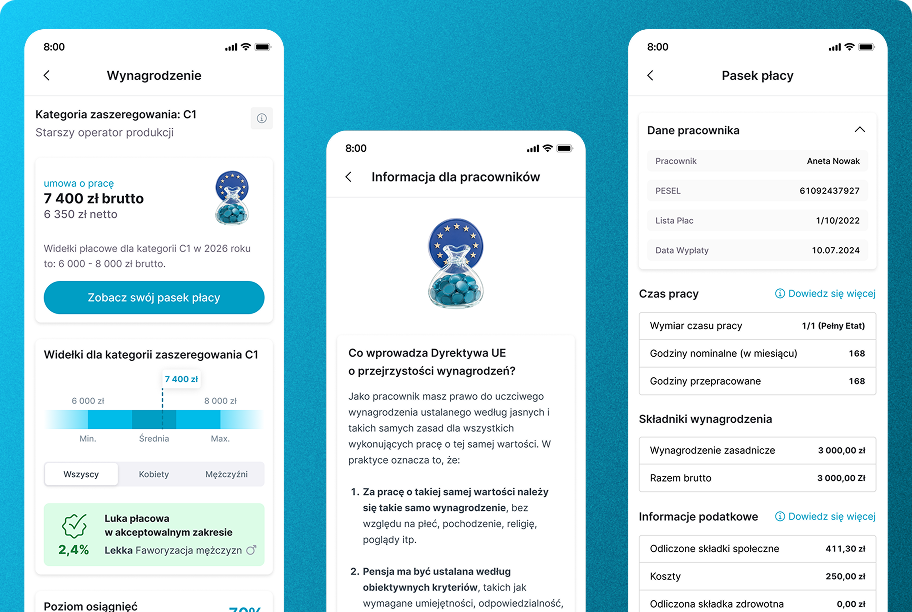
How WinWin Designs an Auditable Trail of Pay Decisions
The Transparent Compensation module in the WinWin system, which is currently being implemented for clients and is designed to help streamline the process from job definition to justifying compensation levels, remains flexible and adaptable to any changes resulting from the law. The module does not replace the HR department, a manager, or a lawyer; rather, it creates a common framework within which it is easier to apply transparent compensation rules, provide relevant information, and document the decision-making process. [7]
A single structure for positions, levels, and pay ranges. Instead of maintaining separate spreadsheets for plants and departments, the organization can standardize its job classification system, job categories, levels, and pay ranges—including minimum, midpoint, and maximum values. This creates a common language for HR, managers, and employees.
Transparent promotion criteria. For each level, the conditions for advancement can be described: required skills, scope of responsibility, experience, performance, or other criteria accepted by the organization. It is crucial not only to define these criteria but also to apply the same version of the criteria to comparable individuals.
Evidence, not just statements. The project provides for the ability to combine data relevant to decision-making—such as the results of periodic evaluations, performance metrics, verified competencies in a skills matrix, or professional achievements—in accordance with the company’s configuration and policies. As a result, recommendations to managers will be based on tangible evidence rather than undocumented impressions. The final decision still rests with the authorized person.
Role-based information. The employee’s view is designed to include their own position and level, the applicable pay range, their position within that range, and development criteria. Managers will receive the context needed for discussions and decisions, while HR will receive a broader view of categories, disparities, and exceptions. Transparency does not mean uncontrolled access to personal data; it means clear rules and an appropriate scope of information.
Decision History and Reporting. The project involves recording the current version of the pay range and criteria, the data used in the evaluation, the person responsible, the date, the rationale, and any approved exceptions. This history is intended to serve as the basis for reporting and analyzing pay disparities before they become the subject of a formal complaint.
In practice, the goal is to ensure that every difficult question has an answer grounded in data. Are we comparing work that is truly comparable? This is determined by job classification systems, job categories, levels, and evaluation criteria. Why is the rate at this point in the pay range? This is determined by the pay range, the employee’s position, and progression rules. What was the basis for assessing whether the criteria were met—related data: performance reviews, effectiveness, the competency matrix, and verified achievements, depending on the configuration. Can the decision be reconstructed after a few months—version history, decision owner, date, justification, and approved exceptions. What the employee, manager, and HR see—controlled access to information appropriate to their roles and a common language for discussing compensation.
It’s worth stating right away what such a system won’t do. It won’t automatically determine whether discrimination has occurred. It will not replace a thorough job description and evaluation or decisions regarding compensation policy. It will not correct incomplete, outdated, or poorly defined input data. It will not assume legal or managerial responsibility from HR, a manager, the board of directors, or the legal department.
Technology serves as the infrastructure for the process here: it helps maintain common definitions, enforces the sequence of steps, records decisions, and facilitates analysis. The quality of the outcome still depends on the quality of the criteria, the data, and people’s accountability. The value of WinWin does not lie in the fact that the system “knows” who was discriminated against. It lies in the fact that the organization can view the criteria, data, decision, and its history all within a single process.
What Does a Good Answer to a Difficult Question Look Like?
Let’s imagine a production worker who asks why she earns less than a male colleague performing similar tasks. The answer should not begin with a comparison of job titles. First, we need to determine whether we are talking about the same job or a job of equal value, and then examine the pay grade, pay range, and objective criteria that differentiate pay.
In a well-organized HR process, an HR professional or manager can review the entire chain: job category and position level, the current salary range, where both individuals fall within that range, the criteria for progression and data sources, the requirements met along with the decisions and approved exceptions, and finally, the history of changes and the rationale for the current rate.
The result will not always be identical pay. A difference may be justified if it is based on objective and consistently applied criteria. It may also turn out that there is no rational justification and an adjustment is needed. In both cases, the organization gains a basis for a specific discussion and decision.
The benefit extends to all roles. Employees know where they stand in the compensation structure, what criteria apply, and what it takes to reach the next level. Managers conduct performance reviews based on shared criteria and evidence: they review recommendations but retain responsibility for the final decision. HR manages the job structure and pay ranges, analyzes discrepancies, monitors exceptions, and prepares data for reporting. Executive management and compliance receive a clear picture of risks, the scale of deviations, and progress on initiatives without having to manually compile data from multiple sources.
Where to Start Before a Complaint Is Filed
There’s no need to start by overhauling the entire compensation policy. A sensible pilot program can focus on a single job family, a single facility, or a single process—ideally the one where the most questions about pay rates and career development arise. The goal isn’t to quickly “check off compliance,” but to verify whether the model provides answers that are understandable to employees and defensible based on data.
- Map out the reality. Compile job titles, levels, pay rates, and local exceptions.
- Define comparability. Establish categories for work that is the same and for work of equal value.
- Determine the range and progression. Describe the levels and the conditions for advancing from one level to the next.
- Cite your sources. Identify the data owner and the update frequency.
- Design the decision and the exception. Document the roles, approvals, and justifications.
- Test it using real questions. Check to see if the answer requires manual investigation.
Effective pilot implementation doesn’t end with simply configuring the tool. It should result in an agreed-upon job category model, versioned progression criteria, a list of data owners, a decision approval process, and sample employee information. These are materials that can later be scaled to other job families and locations.
The simplest quality test involves selecting a few historical compensation decisions. If HR can recreate them without having to search for information across multiple systems, if the manager can explain them using the same language, and if the process owner can identify exceptions and missing data, then the model is beginning to fulfill its purpose. If the answer still requires the expertise of a specific individual, the process is not yet ready to scale.
Transparency begins before the audit
The growing number of complaints filed with the National Labor Inspectorate (PIP) is a warning sign for HR departments and management. Employees are increasingly turning to formal channels when they do not receive a convincing explanation. A complaint alone does not prove the employer’s guilt—it merely means that a response based on facts will be required.
The best time to organize data is not the day of an audit or a court summons. It is when a company is designing its policies on job classifications, pay ranges, performance evaluations, and promotions. That is when you can build a process that is clear to employees, useful to managers, and auditable by HR.
WinWin helps bring these elements together into a single trail: from the structure of the case, through the criteria and evidence, to the decision, the outcome, and the history. It doesn’t promise that technology will resolve the dispute for the organization. It offers something more practical—the ability to show that the decision was not arbitrary.
Can you reconstruct a compensation decision from the past twelve months? The Transparent Compensation module is currently in the pre-registration phase. This is a good time to clarify your requirements, select a pilot area, and determine which data your organization already has and which it still cannot reliably link to a compensation decision. [7]
Sources and Legal Status
1. Bankier.pl / PAP: “Poles Are Becoming More Outspoken in Responding to Discrimination at Work. Hundreds of Complaints Filed with the National Labor Inspectorate” — August 24, 2026
2. National Labor Inspectorate: “Complaint of Discrimination — Details of the Proceedings” — April 17, 2026
3. National Labor Inspectorate: “Introducing pay transparency is a challenge” — April 28, 2026
4. Directive (EU) 2023/970 of the European Parliament and of the Council of May 10, 2023 — transposition deadline: June 7, 2026
5. Office of the Prime Minister: Bill UC127 (list of legislative work by the Council of Ministers) — entry updated on May 25, 2026; second version of the bill submitted for public consultation in late April/early May 2026; status verified on August 24, 2026
6. Ministry of Family, Labor, and Social Policy: “Equal Treatment in Employment” and Article183b, § 1 of the Labor Code
7. WinWin: Transparent Pay module — pre-registration phase
Legal Notice. This material is provided for informational and marketing purposes only and does not constitute legal advice. The data and the status of legislative proceedings were verified on August 24, 2026. The functional scope of the implementation and the process’s compliance with current regulations must be confirmed on a case-by-case basis with the legal department and HR process owners.